
Toledo’s Oldest Multi-Sport Race Meet’s it’s Wettest Morning
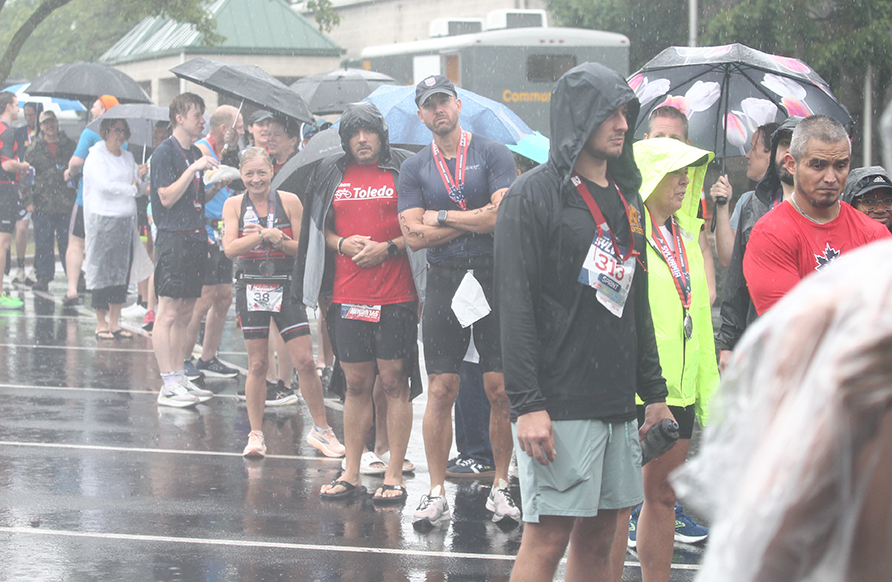
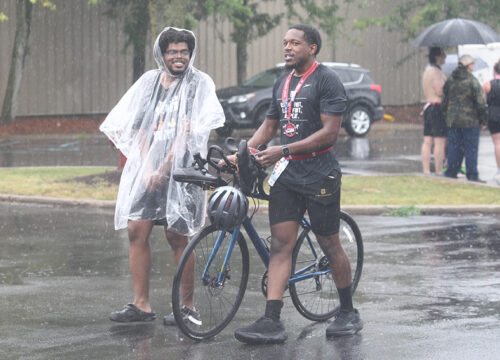
There’s a saying that gets repeated a lot in the Northwest Ohio triathlon community: you don’t pick your race-day weather, you just show up for it. This year, the athletes, volunteers, and staff at the Sylvania Triathlon, Duathlon, Aquabike & Relay showed up for four hours of steady rain — and walked away with one of the most memorable editions in the race’s long history.
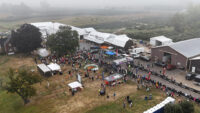
Held every year at Tam-O-Shanter Sports Complex and Olander Lake in Sylvania, Ohio, the Sylvania Triathlon is one of the oldest multisport events in the country, and it’s become the season finale for hundreds of Northwest Ohio triathletes each summer. This year, 592 athletes lined up across the Sprint and Olympic Triathlon, Duathlon, Aquabike, and Relay divisions, supported by roughly 100 volunteers and the full Run Toledo operations team. Here’s what race morning actually looked like — from the athletes in the water to the staff running the show.
A Rainy Morning, and Water Warmer Than the Air
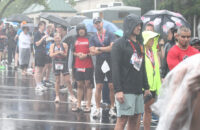
Local triathlete Ashley Hartman, racing her fourth Sylvania Triathlon, said the forecast actually took some pressure off. “When rain was predicted, it was kind of a relief,” she said. “I felt less pressure knowing the conditions weren’t ideal.” Standing on the beach in the pouring rain before the start, she described the scene as chaotic in the best way: “I think of triathlon as an adventure, and that morning definitely felt like an adventure.”
That “adventure” had a strange twist this year: the water in Olander Lake was actually warmer than the air. Michelle Barga, Sylvania Triathlon Director, explained what that meant behind the scenes. “It didn’t affect our wetsuit rules at all because that’s just strictly water temp and doesn’t have anything to do with air temp,” she said. “But it did affect athletes — they did their warm-up swim in the water and then got out under the cold rain. A lot of them got very chilled, so I was worried about some possible hypothermia on some of them that were waiting around a while.” Staff had known the rain wasn’t going anywhere since the day before, which meant race operations stayed largely unchanged — the team simply prepared to run the event wet from start to finish.
Keeping the Bike Course Safe on Slick Roads
For Baily Weatherwax, Run Toledo’s Operations Coordinator, the rain meant getting out on the bike course earlier than usual. “That caused me to go out on the course just a little bit sooner, just to confirm and check in with all of our course marshals and police officers,” Baily said. Crews added 10 to 12 extra caution signs at key intersections, reminded course marshals to flag painted road lines as slippery after every group of riders passed, and made sure police vehicles kept their lights on for extra visibility in the rain.
Ashley felt the payoff of that prep firsthand. Despite missing her first turn on the bike course, “the amazing volunteers got my attention and I turned around,” she said — and still held her goal watts through the rain, the chip-seal section, and the course’s early false flat.
Volunteers Who Embraced the Downpour
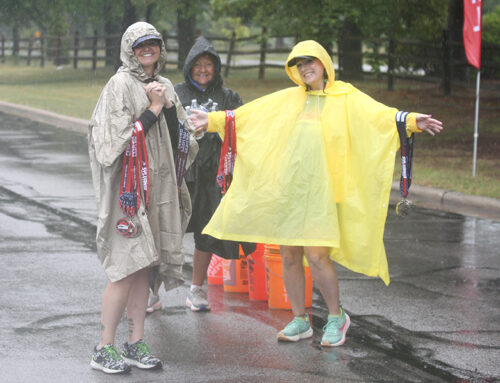
With around 100 volunteers stationed across the swim, bike, and run courses, keeping morale up in a steady rain was its own challenge. “I think it really just came down to our attitudes as staff about it,” Michelle said. “We’re all out here, we’re all getting wet, we’re all getting rained on. We’re just going to make the best of this day and be here for the athletes.” Baily echoed that same energy from the operations side: “I am a glass-half-full kind of guy, so everybody I talk to, just continue with the upbeat and just kind of make light of the situation.”
That attitude showed. “I feel like despite the weather this year, we had more volunteer support for this event than we had in the past,” Michelle said. Athletes noticed too — on social media, the rain quickly turned into a badge of honor, with racers proudly sharing that they survived “the four-hour monsoon” at Sylvania. And when asked whether they’d take the rain again over a typical 90-degree Sylvania race day, both Michelle and Baily didn’t hesitate: they’d take the rain.
The Community Behind the Race
Ask Michelle what keeps volunteers coming back year after year, and it’s not the logistics — it’s the people. “Getting to watch the athletes and support them,” she said. “A lot of people, it’s their first triathlon or it’s their first Olympic-distance triathlon, and just getting to be part of their journey of them reaching their goals.”
Some of those athletes have become part of the race’s identity. Longtime finisher Howard is a fixture the volunteers look forward to seeing every year. And athlete Jake Bocky races the event with his guide, Sean, through Ohana for Autism — swimming alongside each other in the lake, riding a tandem bike together on the course, and running together to the finish. “You just see them come year after year and put in the effort, and the volunteers get to know them,” Michelle said. “Hanging out post-race, just chatting with them and learning about them.”
Toledo’s Oldest Multisport Tradition, Still Growing
The Sylvania Triathlon was started by Jim Donaldson and has been carried forward by Run Toledo as one of the oldest small-platform multisport events in the country. For Baily, it represents the biggest showcase of what the Run Toledo team can pull off in a single day. “This one is a large showcase on just all operational divisions and assets that we deploy for the athletes to kind of celebrate and encapsulate their year-end achievement,” he said, pointing to the coordination across five different police agencies, multiple townships, Tam-O-Shanter, and Olander Park that makes the event possible each year.
Even the cleanup tells the story of the event’s scale. After the rain-soaked race, the Run Toledo team spread four trailers’ worth of equipment, timing boxes, flags, and finish arches across a parking lot to dry out before turning around to prep for the next weekend’s event. “What comes out must go back in somewhere,” Baily said. “We’re only as good as our weakest link, and our weakest links are always strongest.”
Why Sylvania Belongs on Your Race Calendar
Baily put it simply: anyone who skipped this year’s race “missed out on a story that you’d be able to tell forever.” But beyond the rain, the numbers speak for themselves — a 90% start-and-finish rate, a course layout where the swim, bike, and run all stay close together (no long treks to transition), and freshly maintained roads on both the 13-mile and 24-mile bike courses. Add in strong neighborhood spectator support along University Trail and the rest of the run course, and it’s easy to see why Sylvania draws everyone from first-timers to athletes chasing USA Triathlon national ranking points.
If the words “Olympic triathlon” sound intimidating, Ashley and the Run Toledo staff want you to know it’s more approachable than it sounds. “There’s this distance which is super manageable for, I think, anyone who runs and/or bikes on a semi-regular basis,” one staff member noted. “You don’t need a fancy bike, you don’t need the clip-in shoes.” Local resources make getting started even easier: Team Toledo Triathlon offers open-water swim practice at Olander Lake and Centennial Quarry, Cyclewerks hosts women’s-only training rides on Tuesday nights in Whitehouse along with brick workouts, and Dave’s Running in Toledo can help get your gear and training dialed in well before race morning.
Rain or shine, the 2026 Sylvania Triathlon proved what keeps this race alive after all these years: a community that shows up for each other, no matter the forecast.